Posts

Showing posts with the label IFR

G1000 transistion training - flight 2

Yesterday was my second flight behind the G1000. For this flight I kept the foggles on most of the time while shooting 3 instrument approaches - one LPV GPS, one VOR A, and one ILS . The LPV was almost magical. The G1000 coupled with the GFC 700 autopilot took over the vast majority of tasks for the entire approach. I had to push a few buttons now and then, and make power changes and radio calls, but beyond that I was just watching the instruments to make sure things were going as planned - which they did. I was incredible to see the plane going down the GPS-derived glideslope like it was on rails. WAAS is a huge advance for us folks that fly into smaller airports. The VOR -A approach was almost as easy. The extra steps there involve a little more autopilot management and manually switching to VOR mode when getting established on the approach. For the ILS I flew it using the flight director. I felt like I was chasing it a bit back and forth, but my instructor felt a sign...
Night flight and the return

Image
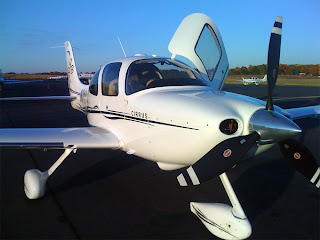
John flew down to KUZA to give me a lift back up to Williamsburg late last week. He arrived in Rock Hill around 5:00 PM and we made a fast turnaround to get back up north before some forecast weather made its way into the area. I took the left seat and we made our way east around the southern side of the KCLT airspace. John picked up our IFR clearance while I got re-acclimated to flying the turbo Cirrus SR22 (it all came back to me quickly thankfully). The sun set about half way to our destination and we watched as the city lights started becoming more and more prominent. I made a check of the KJGG weather every 15 mins or so to see what the ceiling was doing there - it was maintaining at 2300' AGL overcast. When John was flying down south he went through a bit of weather through VA so we expected to see some of that again. However, the way it turned out, we only went through a few small cloud layers that were pretty thin. I would reach down and turn off the strobe light when ...

Long overdue IFR practice

Hopped back in the ole C-172R today to get 4 practices approaches taken care of. I needed to get instrument current before the 16th. Charles was my instructor/safety pilot and we shot the new ILS 25 approach in Newport News, with the autopilot coupled. Then we used the autopilot to shoot a GPS approach into West Point. After that we did a hand-flown VOR approach into West Point without the GPS and a single radio, no GPS approach back to Williamsburg to cap it off. I did ok considering I have not shot a series of approaches like that in a long time. I had a few little kinks to work out, but all in all I felt pretty good about the performance.

Shooting an ILS approach with Microsoft Flight Sim

I thought I'd write up this quick tutorial on shooting an ILS approach with MS Flight Sim for 2 reasons: 1) as an exercise for myself to make sure these procedures are solidly still in my head, and 2) because I have seen that there is some interest in it from VectorsToFinal.com readers. Disclaimer: I am no instructor, so take all this with a critical eye. If I say anything flat out wrong in here, please let me know, but I won't pretend to make this a complete tutorial - some stuff will be left out. :) For this flight, we will ignore ATC completely (which is obvious a terribly bad idea in real life or multiplayer sim games). Before reading my write-up, I'd recommend you take a look at this post from a real-life flight instructor to gain some context. Here's my tutorial (in 1.5MB PDF form) .

First solo in actual IFR

Image
Krista and I went up today (for 1.7hrs total time) with the hopes of punching through a few clouds. We got the chance to do just that, with clouds at 2500' and a scattered layer in places at 1500'. Today added about 0.2 hours of actual instrument time to my logbook, and one of the approaches was ~70% in the clouds (once we came down the glideslope we broke out of the soup fairly quickly). I re-learned how easy it is to get your head turned around with respect to the attitude of the airplane when in the clouds. But my training must have worked because focusing on the instruments and keeping a good scan going kept me feeling on top of things. This was also the first time I have flown out of a towered airport solo since taking up flying again last year. My radio work was fine, though I mumbled once or twice. :) Here is a video of us entering a cloud on the way to KORF:

First Solo IFR Flight (in VFR)

Today I did my first solo flight under an IFR flight plan. It went really well, helped in no small part by very still, cold air. I went to RIC and did the ILS34 approach. From there I shot the full VOR approach into New Kent (W96) and then the VOR back into JGG for 1.5 hours of engine-running time. The ILS went really well, I had it on "rails" all the way down to decision height. Once it was trimmed up the airplane flew right down the glideslope without much help needed from me. The rest of the approaches went well too, though I did come in a little high on my circle-to-land into JGG. I'd rather be too high than too low any day though. :) Things I learned/relearned today: If you are getting "vectored-to-final" you don't have to do the procedure turn Entering the hold (an approach hold/PT) counts as the procedure turn (you don't have to do a full loop unless you need to lose altitude or need time to get setup - any extra loops require ATC notificati...

IFR checkride!

Image
This morning started at 2 AM for me. After feeling so unprepared for the checkride from my previous two flights, my brain was running at 1000mph thinking about the knowledge and skills I would need to demonstrate to the IFR rating examiner. It was 2:30 AM and I wanted to sleep, but all I could think about was how I would fly a DME arc or whether I'd need to demonstrate steep turns. I thought about all of the various weather charts that are available and how I certainly didn't have them all memorized - in real life I look at them to understand them instead of memorizing them - how much would the examiner want me to know off-the-cuff on the weather products?! Where would I need to park at KAKQ when I arrived there to meet the examiner? How exactly are the approach minimums affected when certain airport systems are inop? What was the weather going to do in the next few hours? Did I remember to do all of the cross-country planning the examiner requested? Had I forgotten som...

Last practice before checkride

Today Charles and I went up for my last practice session before tomorrow's checkride. We left the JGG airport and went Northward to the HCM VOR. 5.5 nm out from the VOR we turned right to follow a 5nm DME ARC. We followed that for about 45 degrees and then turned inbound to do the FYJ VOR-A approach using the GPS and autopilot. I had some trouble setting the vertical speed on the autopilot, but Charles showed me what I was doing wrong (I was hitting the ALT key after setting the VS, which puts in back into hold-altitude mode, I just needed to leave it alone after setting the VS). We did a circle-to-land into FYJ on which I overshot the runway centerline a good bit. Charles reminded me to avoid doing that come checkride time. Then we started the VOR approach back into JGG under partial panel with only one VOR (it is harder with one VOR receiver because you need to identify an intersection based on specific radials from two VOR stations). Then he told me to do a hold at the ...

Practice for checkride

Today we went up for a bit to do some maneuvers under the hood (slow flight, stalls, unusual attitudes, timed and compass turns) and to let me get the feel for doing a non-precision approach with the autopilot. We had to dodge clouds the entire time, which made the simulated engine out especially interesting (I had to find a hole in the clouds to descend through on the way to a field). We scheduled my IFR checkride for Friday morning. Wish me luck!!! :)

More practice for checkride

Today we went up for 1.2 hours as more practice for the checkride. We only did approaches this time (no maneuvers) due to time constraints. We did a ILS, GPS, and a partial panel, single-VOR receiver VOR approach. I would guess that the checkride might have similar approaches in it. The flight went pretty smooth. I think I had the least number of errors I have had to date. The biggest thing was that I was a little off on my JGG VOR approach, I reached the missed approach time about 15 seconds before I should have, must have been a little fast. We used the autopilot for the ILS approach, letting it follow the localizer and the glideslope. This leaves the pilot to manage power and rudder (and get mentally ready for the approach). The autopilot was doing some serious S-turning, which was pretty sloppy, but it brought us in pretty darn close. I disconnected it just before we reached 250 AGL and did a touch and go. Today I now have a total of exactly 200 hours in general aviation a...

IFR practice with short field

Today we practiced a GPS approach into a short field ( Hummel, W75 ). We did the GPS 1 approach and circled to land on 19. Hummel field was very busy and since it does not have any real taxiways we had to wait a loooong time to get a chance to backtaxi when no one was landing. Not a place to visit at lunch time on a nice Saturday for a simple touch and go. It was such a nice day that not only were there a million aircraft flying today, but all the pilots were in a good mood - and a bit overly-chatty on the radio. Made it hard to talk on the CTAF/UNICOM today. :) I now have 39.9 hours of instrument time and am working toward doing the checkride sometime very soon. Fingers are crossed that I'm actually ready. :) Since I need to fill out an FAA form (application for checkride) I need to make various calculations of the hours in my logbook. I am inputting my logbook into a database to make it easier. Once that is done, I'll likely hook it into this website.

More practice approaches

Today we went up for 1.7 hours to practice an NDB overlay GPS approach into KPVG and then the DME 27 into Franklin. We did this under an IFR flight plan because it was marginal VFR weather. Had a nice crosswind at 3000' (out of 240 @ 16kts) for the flight to KPVG. I used the autopilot a bit for the enroute phase to KPVG. I had performed poorly on that GPS approach a few weeks ago, so I wanted to do it again. Today went much better. Certainly not perfect but much better. We got a few minutes of actual IFR time in on the way back north to JGG (the clouds starting right at and just under 3000' near JGG). We waited until the last minute to cancel IFR since we weren't seeing the airport until we were within 4 nm. We dumped altitude to get down to 900 and came in to land on 13. I landed quite long but it was a nice smooth touchdown.

Ground review

Today we didn't fly (wx was bad anyway - very windy and overcast) but instead went over some of the oral exam-type of issues. Charles quizzed me on various legalities of flying IFR (currency, minimum equipment, etc.) as well as chart symbology. I also planned a trip from KJGG to KRDU with an alternate of KGSO as an exercise. We tallied up my logbook entries and found that I have all of the minimum requirements to take the FAA IFR exam, except for 2.6 hours of time under the hood. We should knock that out quickly. So the question becomes: Am I READY YET?! :) Still not sure.

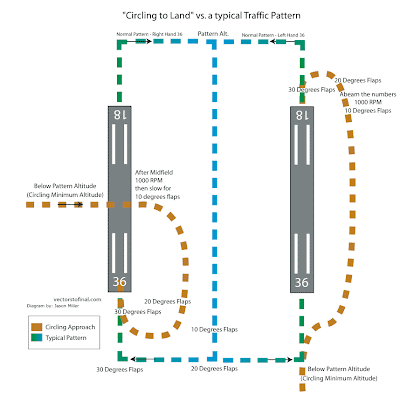
A few Circle-to-Land pattern types

Image
I sometimes have trouble getting out of a VFR pilot's mindset when it comes time to circle-to-land after an IFR approach. I have a tendency to think I need to perform a standard VFR-type traffic pattern which will typically have me go too far away from the runway for a good IFR approach (when on an IFR circling approach - which is an approach where you don't come in straight-in on final - you need to stay close to the airport because it is required that you keep it in sight). I brought this up with Charles a few weeks ago and he gave me some pointers which I have "digitized" in this diagram. This is by no means official advice, but I find this picture very useful to get my head screwed on straight when making a non-straight-in approach. :) The orange dotted line represents a course you might take for a circle-to-land and the blue/green dotted lines are for standard patterns (one to the right and one to the left). There are obviously other ways you might have to ci...

IFR practice approaches

Today we spent some time shooting approaches. We did the Wakefield GPS-20 approach, the Franklin VOR-DME-27, and then the Franklin VOR-9. Things I need to improve on: Maintaining assigned altitude Talking on the radio with more position reports Remembering to start the approach timer on time We did touch-and-goes for the Wakefield and VOR-9 approaches with a bit of a crosswind. The landings were interesting but I did fairly well. The Williamsburg landing was not quite as smooth, I kind of plopped it in pretty hard at the last second. I had a great descend going and once I crossed the threshold the descent rate picked up a good bit. I tried to get a quick flare in, which helped, but we still kinda smacked it in. There is a "swamp monster" off the approach end of JGG runway 31 (a weird wind pattern over the swamp) and it grab us a bit just before the fast descend kicked in. I came in intentionally high to avoid it and we didn't get it too bad. :)

First time in actual IFR conditions

Image
Today I woke up to find that the ceiling at JGG was at 800ft and that the weather around the general area was all IFR. I called Charles to see what the plan should be and he told me to come on out and that, if the ceiling hit 1000ft, we'd go get some actual instrument time in. I went out to the airport and after preflighting we chatted for a bit in the office. He quizzed me on filing alternate airport destinations (when the weather requires it) and what the value of filing an alternate is (the primary one being that ATC has a good idea where you might head in bad weather if you lose communications). Charles then mentioned that he wouldn't throw any curve balls at me on this flight, since going into the "soup" for the first time would be enough for me to manage. He then said that if an emergency happened in flight that he'd let me do whatever I felt made sense, until I started to do something wrong. He's never actually said that aloud before. :) The weather...

Practicing maneuvers under the hood @ JGG

Today we went up for 1.4 hours to practice some air work (stalls, slow flight, unusual attitudes, steep turns, etc.). I needed to be a little quicker on my throttle changes during some of the slow flight - I lost 200 feet at one point because I was trying to use too small of corrections in the throttle setting. The steep turns were pretty good. We did a couple of extra ones to try to come around and hit our own wake to bounce the plane a little bit. We made it work a few times. :) I am a fan of G-forces, at least the minor G-forces you get in steep turns - I could sit there and do those all day (if I set the trim right). We ended the practice by shooting the VOR-B approach into Williamsburg partial panel. I did fairly well on that except for shooting right by the initial approach fix (the HCM VOR) at first. But I just flew out to get some room from the VOR and turned back in. I did fine the second time. I even remembered to start the timer at the final approach fix and to broad...

IFR flight - back in JGG for holds

After not getting to fly for about two weeks due to bad weather and an alternator problem, I went up today for 1.5 hours of work on "holds". We went to the HCM VORTAC and practiced various hold entries. After two normal entries, we did a few with partial panel. Then, to cap it off, we did an intersection hold with partial panel - VERY mentally challenging. We went over the basics of the autopilot, which, to-date, I have only used when flying on my own VFR trips. We'll use it for a few approaches next time. The weather was fairly nice, a few decent updrafts here and there had me struggling with my altitude. We ended with a simulated engine-out abeam the numbers in the pattern at JGG which I did fairly well on (the last one I did was right after I started flying again and in that instance I would not have made the runway - very bad). I ended the trip to the airport watching a guy pull his Cirrus SR22 up to his hangar. I was quite jealous. :)

IFR written finished

Took the official IFR written test tonight and did pretty well; got a 95% (missed 3/60). I used a CATS office. I think it is time to start doing more than one flight with Charles per week in prep for the practical flight test...

Sportys practice written IFR test

Just took the Sporty's free practice IFR written test exam and got a 92/100. It went really quick, took about 30 minutes to do the 60 questions. I didn't get any lengthy questions though, so that's probably why (the questions are chosen randomly from a set of many 100). I studied by going through the Jeppesen study guide - it was pretty nice but it was very painful to slip through the book to find charts (the charts are not always beside the question). If I had to do it again, I can't decide if I'd go with the book or with the electronic version. I was initially turned off by the fact that the web site study guide was on a subscription basis, but a this point, I don't think that would have been a problem for me.